I’ve walked more than 40,000 moms through pregnancy, and there’s a summer complaint I hear come up time and again: pregnancy melasma.
What’s that? Sometimes called the “mask of pregnancy,” it’s the dark spots that show up on your face while pregnant (usually sometime in the second trimester). And it happens to up to 70% of pregnant people, myself included.
Here’s the thing you should know. Everyone asks me how to fix it, but it’s actually not about treatment. You can’t use retinol during pregnancy, after all. So what should you focus on instead? Prevention. The single biggest thing you can do to prevent pregnancy melasma is to use the right sunscreen, daily, from the beginning. (Not to mention that pregnant skin sunburns more easily, so yeah, good sunscreens are our friend.)
TL;DR: There are a lot of seemingly weird things that happen during pregnancy, and for many moms, pregnancy melasma is on the list. It’s actually not weird at all, but with many of the skincare ingredients you’d normally reach for being off the table, sunscreen ends up becoming your best friend. I’m walking you through 7 I’d actually buy, broken into face and body, across price ranges. Two of them double as baby-safe sunscreens for next summer, which is amazing. Gotta love a product that keeps working.

This site contains affiliate links, meaning that we earn a small commission for purchases made through our site. We only recommend products we personally use, love, or have thoroughly vetted.
Quick comparison: all 7 pregnancy-safe picks
| Product | Best For | SPF | Mineral % | Water Resistant |
|---|---|---|---|---|
| La Roche-Posay Anthelios Tinted Mineral | Face (Top Pick, Foundation) | 40 | 17% TiO2 + 8% ZnO | Yes (40 min) |
| ILIA Super Serum Skin Tint | Face (Splurge) | 40 | 12% ZnO | No |
| Supergoop Mineral Mattescreen | Face (Top Pick, Carry-With-You) | 40 | 17.4% ZnO + 1.3% TiO2 | No |
| Vanicream Facial Moisturizer | Face (Drugstore) | 30 | 19.5% ZnO | No |
| Blue Lizard Sensitive | Body (Top Pick) | 50+ | 10% ZnO + 5% TiO2 | Yes (80 min) |
| Tubby Todd Mineral | Body (Baby-Safe Crossover) | 50 | 19.6% ZnO | Yes (80 min) |
| Earth Mama Tinted Mineral Lotion | Body (Pregnancy-Brand) | 40 | 25% ZnO (non-nano) | Yes (40 min) |
What the Research Says About Pregnancy-Safe Sunscreen
That’s not just me saying it. Researchers have been studying this for decades, and the pattern keeps showing up the same way. While most trials are small (we don’t love performing research on pregnant people, for obvious reasons), multiple trials reached the same conclusion: daily broad-spectrum sunscreen is the single most effective thing you can do to prevent dark spots on your face during pregnancy. Not a treatment. Not a serum. The right sunscreen, used every day.
The research also keeps pointing to timing: starting in the first trimester, before you see anything, is when the right sunscreen does the most good during pregnancy (though please use it daily throughout, if possible).
When you’re worried about safe pregnancy ingredients on top of all the money you’re already shelling out for baby things, it’s easy to feel overwhelmed by the idea of choosing a pregnancy-safe sunscreen you’ll actually wear daily. I’ve got you covered.
The 4 face sunscreens I’d actually buy during pregnancy
We deserve sunscreens we actually trust on our faces. When you’re pregnant, you’re already worried about enough; what’s in your sunscreen shouldn’t be on this list.
So I picked four options I love to make it easy on you:
- Two that wear makeup-like (so they can replace your foundation if you want)
- Two you’d actually carry with you for the reapplication needed for pregnancy melasma prevention
I know sometimes the “cleaner” options are pricier, so I tried to hit every price range. Drugstore, mid-tier, and splurge. All here, all pregnancy-safe.
1. La Roche-Posay Anthelios Tinted Mineral Sunscreen
It’s 7:42am. You’re at the bathroom mirror trying to do something with your face before the day starts swallowing you whole, and you need that something to count as sunscreen AND look like you tried. This is the bottle that does both.
The dermatologist-go-to tinted mineral sunscreen for pregnant skin.
Built for a wide range of skin tones and the mineral white cast disappears.
The one pregnancy-skin-care guides actually name by name, which is why it earned the everyday foundation slot.
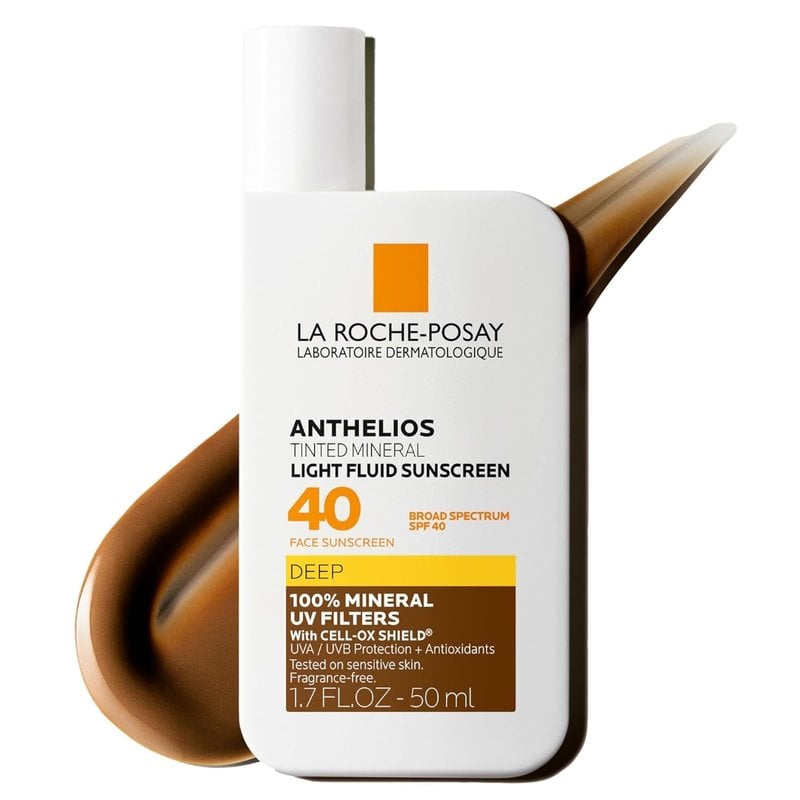
The newer Tinted Mineral Light Fluid comes in four shades, which is rare for a mineral SPF, and it disappears into your skin instead of sitting on top of it like a ghost.
One quick caution on naming. La Roche-Posay makes multiple Anthelios face products, and not all of them are mineral. The one you want is the Tinted Mineral version with both titanium dioxide AND zinc oxide listed in the active ingredient panel. If anything else is listed, it’s a different SKU.
Pro Tip
Warm a dime-sized amount in your palm for 10 seconds before pressing into your skin. Mineral sunscreens blend so much better when they’re slightly warmed.
2. ILIA Super Serum Skin Tint SPF 40
love ILIA. It’s the splurge pick that earns its price, and it does it by doing three things at once: serum, sunscreen, tinted base. One product, three lines of your routine, gone. That’s the morning math that makes sense when your skin is acting like a parched houseplant and your dresser is covered in things you can’t use right now.
The skin tint that doubles as serious sunscreen.
Perfect for skin that's quietly dehydrated under all that prenatal water you keep drinking.
Independent UV testing says it still blocks 99% of UVA. Not all mineral SPFs hit that.
The splurge pick that earns the price, which is why it shows up on every dermatologist's pregnancy-safe favorites list.

Per independent testing from The Sunscreen Tester, it blocks 99% of UVA, which is unusual performance for a 12% zinc formula.
Honest catch. ILIA doesn’t claim water resistance on the Super Serum, so this isn’t your beach SPF. It’s your every-day-from-the-car-to-the-thing SPF.
If the splurge isn’t where you are right now (totally fair), Tower 28 SunnyDays SPF 30 Tinted is the budget mineral tinted that gets recommended a lot in the same conversations. Less serum, less shade range, but real protection.
3. Supergoop Mineral Mattescreen SPF 40 (Top Pick: Carry-With-You)
Yes, I know Supergoop’s most-Googled products are chemical. We’re getting to that. But this one? Fully mineral, confirmed via DailyMed (and, you know, reading the ingredient list . . . )
The mineral SPF that doesn't pill, doesn't shine, doesn't ghost your face.
17.42% zinc oxide + 1.33% titanium dioxide (fully mineral, no chemical filters)
Built for reapplication: matte, blurring finish that layers over makeup without rolling off.
The one you actually keep in your bag, which is why it earned the carry-with-you spot.

The reason this is the Top Pick for Carry-With-You is the texture. It’s matte, blurring, slightly pore-smoothing, which means you can actually reapply it over your makeup at 2pm without rolling off everything you put on at 8am.
That’s the SPF you can actually reach for with one hand while the other one’s holding a preggie pop.
4. Vanicream Facial Moisturizer SPF 30
The sunscreen to keep on the bathroom counter for the days you don’t want to think about your face. No tint, no makeup, no shade-matching. Just a clean mineral face moisturizer that won’t pick a fight with skin that’s suddenly reactive to everything.
The drugstore face SPF dermatologists actually use themselves.
Free from dyes, fragrance, parabens, lanolin, formaldehyde, and the long list of things pregnant skin reacts to.
A super clean, single-mineral formula at a strong concentration.
Built for sensitive everything, which is why it's the recommendation for pregnancy rosacea, melasma, and reactive-skin readers.

If pregnancy could send you a welcome packet, Vanicream would be inside it. Friend, it’s that boring. That’s the compliment.
Side note: a lot of moms I know are loyal to Skinpharm 100% Mineral Tinted SPF for their face. Good news for the Skinpharm crowd: the formula is mineral-only, pregnancy-safe, and your existing tube is fine to keep using. I didn’t put it in the main lineup because the brand’s a smaller boutique and harder to source for busy mamas, but it works.
The 3 body sunscreens I’d actually buy during pregnancy
Body sunscreen is where you can really get bang for your buck because two of these three picks are both pregnancy-safe and baby-safe. So, when summer ends and you haven’t burned through the end of the bottle you’re on, keep it! You have a head start on next summer’s diaper-bag stash because you can use it for baby!
1. Blue Lizard Sensitive Mineral Sunscreen SPF 50+ (Top Pick: Body)
You know what I love about Blue Lizard? The cap turns blue when you’re in UV. It’s right there on the counter, glowing at you, basically saying hey friend, reapply. That’s the kind of cue I need when my brain is full of 47 other things and I cannot be expected to remember whether the porch counts as sun exposure.
The mineral body sunscreen with a bottle that tells you when to reapply.
The cap turns blue in UV, a super fun a visual cue that matters more during pregnancy, when even short sun exposure can trigger melasma flares.
The body sunscreen pediatricians and OBs both recommend, which is the rare pregnancy-AND-baby crossover.

It’s the body sunscreen I keep recommending because it does the job and tells on itself when it needs more.
Bonus: this is actually our top pick for baby-safe sunscreens too. Keep whatever’s left so you can use it on that precious, perfect baby skin next year.
2. Tubby Todd Mineral Sunscreen SPF 50
Tubby Todd’s the brand that earns its five-star reputation in customer service alone. (Some mom, somewhere, has a story about a Tubby Todd rep solving something at 9pm. You know the one.) The sunscreen lives up to the brand.
The mineral body sunscreen made by the brand pregnant moms trust for the most sensitive skin.
Built by the bath-time-products brand moms love for diaper rash and eczema relief during pregnancy.
The cleanest formula on this list, which is why it shows up on every "what I'm actually using" pregnancy-safe roundup.
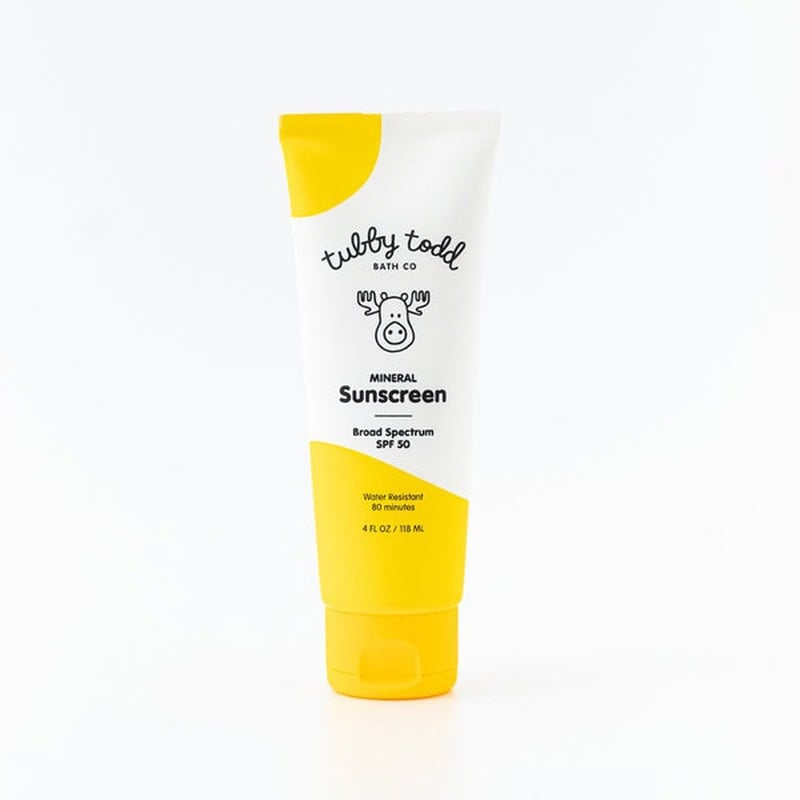
It’s the cleanest formula on this list, and one of the rare sunscreens that’s both pregnancy AND baby-safe.
Don’t finish your bottle this summer? Stock it for next summer’s diaper-bag stash. (See the baby-safe sunscreens I actually use on my own kids for the full crossover.)
3. Earth Mama Tinted Mineral Sunscreen Lotion SPF 40
Earth Mama is the brand whose entire identity is pregnancy-everything: nipple butter your OB clinic stocks, perineal spray your midwife hands you, belly butter, postpartum bath herbs. If your bathroom shelf has any Earth Mama products on it already, this is the body sunscreen that fits right in.
The mineral body sunscreen made by the brand pregnant women already trust for nipple butter and labor prep.
OB-clinic-stocked and midwife-recommended, which is why it shows up on every pregnancy-skincare list before the trendier brands.
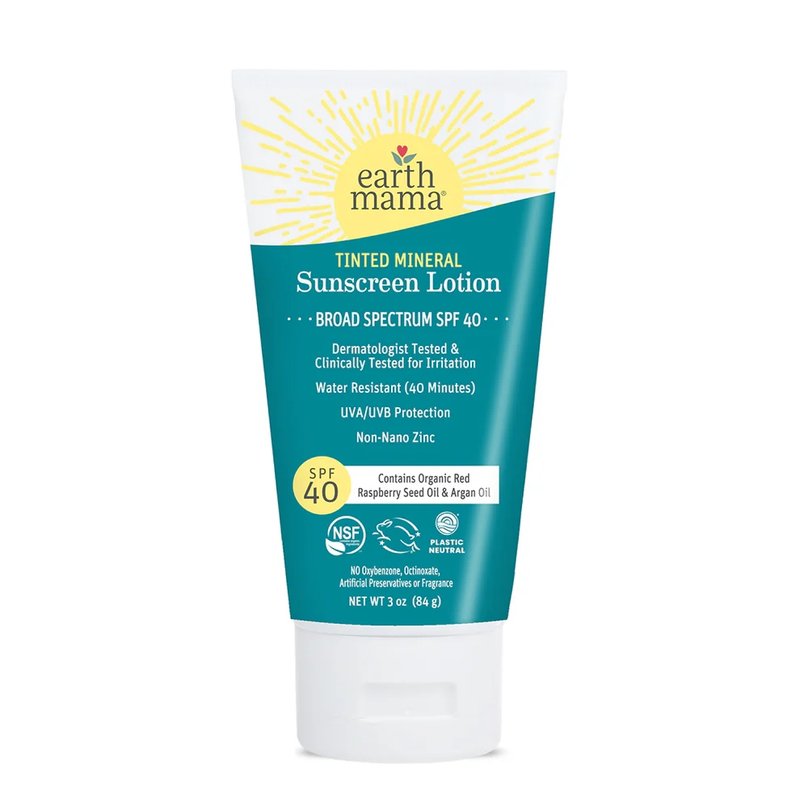
The standout fact: at 25% non-nano zinc oxide, this is the highest mineral concentration on the entire list. A tinted body sunscreen with this much zinc is genuinely hard to find.
One thing worth knowing if it matters to you: Earth Mama uses beeswax in the inactives, so this one isn’t vegan. If that’s a dealbreaker, Blue Lizard or Tubby Todd are your body picks (both vegan).
What you’ve had to put down (and why your sunscreen matters more right now)
When I saw two pink lines for the first time, I immediately called my friend Tessa and asked, “What all do I need to stop using?” The list, I was irritated to learn, was long. It wasn’t just about sushi and unpasteurized cheese. There was no more retinol or salicylic acid. My acne-prone skin wasn’t happy.
And as a “geriatric pregnancy,” I felt like I needed my daily brightening serum nearly as much as I needed water. Until I looked at the ingredient list, and it was out too. UGH.
So now you’re pregnant, your hormones are doing wildly creative things to your skin, and the toolkit you’d normally reach for is suddenly very small. But there’s one easy tool I didn’t know about then, and it’s the right pregnancy-safe sunscreen.
Quick note: The list of “shoulds” and “shouldn’ts” during pregnancy is enough to make anyone go mad. If you’ve already used something you “shouldn’t” have, so has basically every pregnant mom ever. So let’s not freak out, guilt trip ourselves, or fall into comparison traps or think we’re bad moms. (Hey, looking at you: you’re looking up what’s safe during pregnancy. You’re already a good mom.)
I’m just here to make it easy for you to make simple switches where you want and need to. That’s all.
About melasma, the “mask of pregnancy” nobody warned you about
Melasma is the technical name for the brown or grayish patches that show up on many people’s faces during pregnancy. They’re typically most prominent on the cheeks, forehead, upper lip, and sometimes the bridge of the nose.
What causes it? A fun combo of pregnancy hormones (hey, estrogen and progesterone) cranking up melanin production. With sun exposure, UV and visible light trigger that already-amped melanin, and it turns into pigment patches (aka dark spots).
And melasma isn’t the only thing. Pregnant skin actually sunburns more easily. Full stop. Pregnancy hormones make your skin more reactive, and increased blood flow brings more heat to the surface. Add melasma on top of that and you’ve got two real reasons to wear sunscreen daily, not just one. Burns hurt, peel, and (after the fact) trigger more pigment irregularities. They also fade your existing skincare investments faster, which is just plain rude.
As an anxious mama, I like to control what I can. You can’t control the hormones, but you CAN control how well you’re protected against the light.
What do you mean, “the light”?
Let’s get sciency for a sec, k? Don’t want to? Just skip down.
Most sunscreens protect against UVA and UVB, the two ultraviolet wavelengths that cause skin damage. But melasma is also triggered by visible light: the kind of light that comes through your window on a cloudy day, the kind that bounces off your phone screen, the kind most sunscreen probably isn’t blocking. The American Academy of Dermatology specifically recommends tinted sunscreens with iron oxide for melasma protection because iron oxide is one of the few sunscreen ingredients that blocks visible light too.
So in our recs above, you may notice the face picks are all tinted (with one exception). Most people think it’s for cosmetic reasons, but actually, it’s because tinted sunscreen often means iron oxide, which means visible-light protection, which is the kind of melasma defense that actually works.
Pro Tip
Reapply. Even on cloudy days. Even when you’re not “in the sun.” Melasma can trigger on incidental exposure: the walk from your car to the building, the time on your back porch, the hour at the kid’s soccer practice. Daily, broad-spectrum, reapplied. That’s the whole protocol.
Ingredients to skip during pregnancy (and why)
These are the ingredients I look at the label for. The ACOG’s official list of chemicals to avoid in pregnancy covers some of these directly. Others come from the broader dermatology research base.
Oxybenzone (sometimes labeled benzophenone-3). This is the big one. It’s a chemical sunscreen filter that crosses the placenta and shows up in cord blood and breast milk. ACOG flags it explicitly. If you see it on the active ingredients panel, skip the bottle.
Retinyl palmitate. A form of vitamin A that hides in the inactive ingredients list of some sunscreens. The AAD recommends avoiding topical retinoids during pregnancy, and the skin converts retinyl palmitate to retinoic acid. Scan the full ingredient list, not just the actives.
Octinoxate and homosalate (and the rest of the “octi-” filters). Pregnancy-focused dermatologists flag these for systemic-absorption questions, and the EU has restricted them more aggressively than the US. Worth knowing: some of the most beloved tinted face sunscreens (looking at you, EltaMD UV Clear Tinted) actually contain octinoxate alongside zinc oxide. Read the active-ingredients panel.
If you used any of these before you knew, you’re fine. Don’t waste a second feeling guilty about the months you used them before you knew. Just make switches where you can.
What about Supergoop Unseen, Glowscreen, and the chemical favorites?
Friend, I get this question a lot. So let’s address it head-on.
Supergoop Unseen Sunscreen, Play Everyday, regular Glowscreen, and Glow Stick: all chemical. Avobenzone, octisalate, octocrylene, sometimes homosalate. They’re beloved formulas. They wear beautifully. I LOVE them! They’re also not the formulations I’d reach for during pregnancy. I promise; it makes me sad too.
Here’s the kicker for the Glowscreen crowd: Supergoop also makes Mineral Glowscreen Soft-Radiance Drops. They ARE mineral, pregnancy-safe, and give you something close to the original Glowscreen finish without the chemical filters. If you’re already a Glowscreen loyalist, the Mineral Drops are your switch path.
Same kind of note for Sun Bum, Coppertone, Banana Boat, and Hawaiian Tropic. Most of their flagship sunscreens are chemical. There are exceptions (Sun Bum has a mineral line), but the brand-recall of “sunscreen equals these names” usually points you at the chemical version. Read the active ingredients panel.
What’s coming this summer that I’m watching: bemotrizinol
One thing worth knowing about. On June 9, 2026, the FDA approved bemotrizinol as a sunscreen active ingredient. It’s the first new sunscreen ingredient added to the FDA’s approved list in 20 years. It’s been used in European, Asian, and Australian sunscreens for years, with a strong safety record including in pregnancy contexts.
US-formulated bemotrizinol sunscreens are expected to hit shelves August 9, 2026. I’m watching closely. If the early formulations look pregnancy-friendly (no oxybenzone or homosalate paired with them), bemotrizinol might be the next major addition to lists like this one.
For now: mineral. Always mineral during pregnancy. But this is the ingredient to watch for next year.
Why trust us?
I write Undefining Motherhood full-time and have walked more than 40,000 moms through pregnancy, postpartum, and loss. I’m not a dermatologist, but I’ve done the research with the same depth I used to bring to academic work, and I’ve personally swapped my entire skincare lineup through pregnancy more than once. Every safety claim in this article is sourced to ACOG, the AAD, the FDA, or peer-reviewed dermatology research. Nothing in this article was sponsored.
For every product, I cross-checked the active ingredients against the FDA’s DailyMed database, the brand’s own ingredient page, and at least one independent dermatology or pregnancy-focused review. When two sources conflicted, I went with the primary source (the brand’s label or a regulatory body). The picks here are products I’d actually buy and would hand my best friend if she texted me from the sunscreen aisle. If I change my mind about a product after publishing, this article gets updated.
Pregnancy-Safe Sunscreens FAQ
Yes. The American Academy of Dermatology specifically recommends mineral sunscreens (formulas with zinc oxide and/or titanium dioxide as the active ingredients) during pregnancy. They sit on top of skin rather than absorbing into it, which is why dermatologists default to them for pregnant patients.
ACOG flags oxybenzone, phthalates, and parabens as chemicals to avoid during pregnancy. Beyond that list, many dermatologists also recommend skipping retinyl palmitate (it converts to retinoic acid in the skin), octinoxate, and homosalate based on emerging research and regulatory restrictions in the EU and UK.
Melasma, or the mask of pregnancy, refers to dark spots on your face that show up during pregnancy. Research keeps pointing to the same protocol: start using daily broad-spectrum sunscreen in the first trimester and continue throughout pregnancy.
Usually yes, and several of the picks on this list are specifically both pregnancy-safe AND baby-safe (Blue Lizard Sensitive and Tubby Todd Mineral are two examples). The catch: baby sunscreens are usually untinted, so you won’t get the visible-light melasma protection that iron-oxide-tinted face sunscreens provide.
The bottom line
Pregnancy takes a lot of things off your skincare shelf. Sunscreen isn’t one of them. If anything, it’s the product doing the most work during these nine months: protecting against melasma, holding the line on the hyperpigmentation you can’t actively treat right now, and standing in for the active ingredients you’ve had to put down.
Pick mineral. Pick tinted for your face (iron oxide protects against visible light, not just UV). Pick the bottle size that means you’ll actually reapply. Don’t agonize about what you used before you knew. Just switch what’s in your bag this week and trust that the next eight months of consistent protection will do far more than any beat-yourself-up regret about the months before would.
You’ve got this, friend.
More articles that might interest you
- The 30+ pregnancy-safe skincare products I actually use (because sunscreen isn’t the only label you’re suddenly reading)
- The baby-safe sunscreens I actually use on my own kids (for next summer, with Blue Lizard and Tubby Todd carrying over)
- 10 maternity swimsuits to dress your pregnancy bump (so you have something cute to wear all that sunscreen with)
- The pregnancy planner checklist I wish I’d had (the rest of your trimester-by-trimester game plan)