
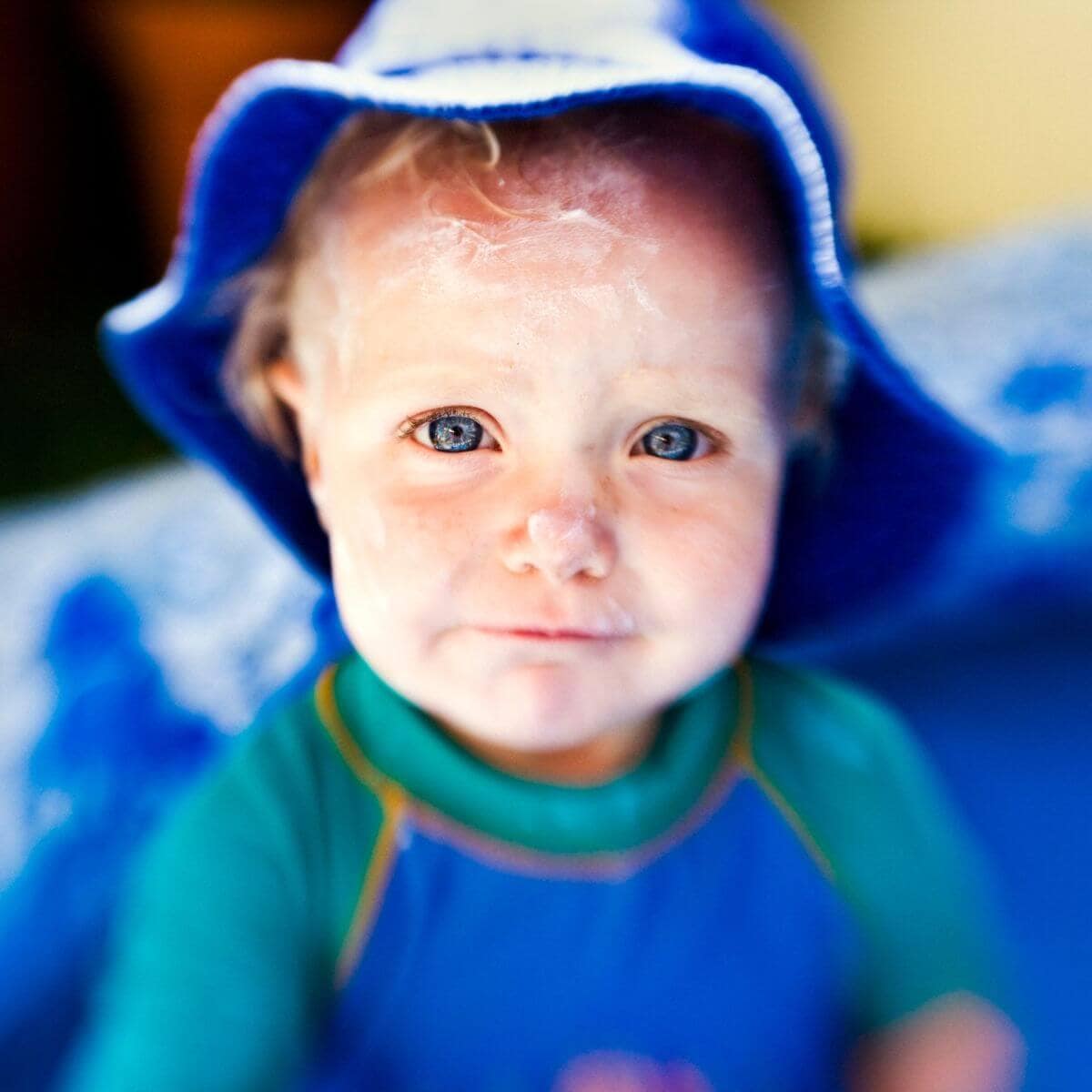
We’ve all been there, right? Scrolling through the sunscreen options on Amazon, baby steal the phone, trying to remember what that TikTok pediatrician said about safe sunscreens for babies. Half say “natural,” and somewhere in the back of your brain, a friend’s voice is saying half of these are basically banned in Europe.
Where do you even start?
Right here, friend. I’ve read the FDA monograph, the AAP guidance, the EWG report, and the thread on our own Motherload village chat where moms are right now comparing notes on what actually works. For babies, the sunscreen bar is way higher than for adults — thinner skin, less-developed liver, and a ratio of surface area to body mass that lets more chemicals absorb. So here’s the rundown you actually need.

This site contains affiliate links, meaning that we earn a small commission for purchases made through our site. We only recommend products we personally use, love, or have thoroughly vetted.
The quick answer
For the parent whose baby is already melting down in the stroller:
- Top pick: Blue Lizard Baby Mineral SPF 50+
- Best overall mineral: Thinkbaby Safe Sunscreen SPF 50+
- Best budget: Babyganics Mineral SPF 50+
- Best for eczema: Aveeno Baby Continuous Protection SPF 50
- Best splurge: Tubby Todd Mineral Sunscreen SPF 50
- Best stick for face: Earth Mama Baby Mineral Sunscreen Stick SPF 40
The 6 baby sunscreens I’d actually buy
All six picks below are mineral (zinc oxide and/or titanium dioxide as the only active ingredients). All six are FDA GRASE on every active they contain. Most are EWG Verified, which is a separate, stricter standard requiring full ingredient transparency, no hormone-disruption flags, and both US and European UVA protection thresholds.
Quick comparison
| Sunscreen | Price | Type | Active ingredients | SPF | Water resistant |
|---|---|---|---|---|---|
| Blue Lizard Baby Mineral | $$ | Mineral | Zinc oxide + titanium dioxide | 50+ | 80 min |
| Thinkbaby Safe Sunscreen | $$ | Mineral | 20% non-nano zinc oxide | 50+ | 80 min |
| Babyganics Mineral | $ | Mineral | Non-nano zinc oxide | 50+ | 80 min |
| Aveeno Baby Continuous Protection | $ | Mineral | 21.6% zinc oxide | 50 | 80 min |
| Tubby Todd Mineral Sunscreen | $$ | Mineral | 19.6% zinc oxide | 50 | 80 min |
| Earth Mama Baby Mineral Stick | $$ | Mineral (stick) | 22% non-nano zinc oxide | 40 | 40 min |
1. Top Pick: Blue Lizard Baby Mineral SPF 50+
If you’re going to buy one baby sunscreen this summer, make it this one. What earns it the top spot isn’t ingredient supremacy (Thinkbaby technically wins that race); it’s the fact that you’ll actually want to use it. The texture blends in noticeably easier than thicker zinc-only formulas, and the bottle has a clever party trick: it turns blue when UV light is strong enough to require sunscreen. Built-in cue to reapply.
The mineral baby sunscreen that wins the "I'll actually put this on my kid every day" award.
Zinc oxide plus titanium dioxide, EWG verified, fragrance-free.
The bottle has a clever party trick: it turns blue when UV light is strong enough to require sunscreen, which is the kind of thing you don't know you wanted until you have it.
Blends more easily than thicker mineral options, which is why it earned its repeat-purchase reputation.
- Both active ingredients carry full FDA GRASE status
- UV-detection bottle turns blue in strong sun (built-in reapplication cue)
- 80-minute water resistance
- Fragrance-free, paraben-free
- Slight white cast on darker skin
- Still requires effort to wash off (mineral sunscreens generally do)

This is also the one our Motherload members keep landing on when other minerals feel like too much to wash off. A sunscreen you’ll actually put on every day beats a sunscreen with marginally better ingredients sitting in the cabinet.
2. Best Overall Mineral: Thinkbaby Safe Sunscreen SPF 50+
If ingredient profile is what you’re optimizing for, this is the one. 20% non-nano zinc oxide, the concentration pediatric dermatologists most often point to, and nothing else on the active ingredient panel. It’s the most-mentioned baby sunscreen on Reddit for a reason; the safety profile is hard to beat.
The mineral baby sunscreen that consistently tops the charts in mom communities.
Non-nano zinc oxide as the only active, and it's free of oxybenzone, avobenzone, parabens, phthalates, PABA, and fragrance.
The texture is on the thicker side, which is just the deal you make for ingredient profiles this clean.
- 20% concentration of the active ingredient (a level widely recommended by pediatric dermatologists)
- EWG Verified, reef-safe
- 80-minute water resistance, broad spectrum SPF 50+
- No synthetic fragrance
- Leaves a slight white cast, especially on darker skin
- Requires patience to blend in
- Harder to wash off than thinner formulas (oil cleanser fixes this)

The honest tradeoff, and why it’s not our top pick: it’s thick. Non-nano zinc, by its nature, doesn’t disappear into skin the way thinner formulas do. You’ll work it in for longer than you would Blue Lizard. That’s the deal you’re making, and on a baby, it’s the right one when the priority is ingredient purity over speed of application.
3. Best Budget: Babyganics Mineral SPF 50+
Mineral baby sunscreen that doesn’t require the splurge. The white cast is heavier than Blue Lizard and the texture is thicker, but the per-ounce price is lower, and when you’re going through a bottle a week at the pool, that adds up.
The drugstore-shelf mineral baby sunscreen that doesn't make you feel like you compromised.
The kind of bottle you can grab at Target on vacation when you forgot to pack yours, without panicking about what's on the back of the label.
Heavier white cast than the pricier picks; that's the budget tradeoff and it's a fair one.
- Non-nano zinc oxide as the active ingredient
- Broad spectrum SPF 50+, 80-minute water resistance
- Fragrance-free and tear-free
- Widely stocked at Target, Walmart, drugstores, and Amazon
- Lowest per-ounce price of the mineral picks here
- Visible white cast that doesn't fully rub in
- Thicker texture
- Some moms detect a faint scent despite the fragrance-free claim

It’s also widely stocked, so when you forgot to pack sunscreen and you’re standing in a Target on vacation, this is the safe drugstore-shelf pick.
4. Best for Eczema: Aveeno Baby Continuous Protection Zinc Oxide SPF 50
If your baby has eczema or skin that flares at the slightest provocation, this is your pick. With 21.6% zinc oxide (a hair above the pediatric-dermatologist 20% benchmark) plus Aveeno’s signature colloidal oat extract (the same skin-soothing ingredient in their eczema lotions), this one’s a no-brainer for sensitive-skinned babies.
The mineral baby sunscreen pediatricians keep recommending for kids whose skin flares at the slightest provocation.
Thicker than the lighter mineral picks, which is partly why it stays on so well and creates such a real barrier for irritated skin.
- High concentration of zinc oxide (21.6%)
- National Eczema Association accepted
- Colloidal oat extract soothes irritation-prone skin
- 80-minute water resistance
- Widely stocked; easy to find anywhere
- Subtle oat scent (not perfumed, but not fully scent-free)
- Heavier application than thinner mineral lotions
- White cast more visible than Blue Lizard

The texture is thicker than the lighter mineral options, but that’s a feature, not a bug. It stays where you put it and creates a real barrier for skin that’s already mad. There’s a subtle oat scent (not perfumed, but not fully scent-free either). For most eczema kids, the trade is worth it.
5. Best Splurge: Tubby Todd Mineral Sunscreen SPF 50
The mineral baby sunscreen from the brand that’s already in a lot of UM moms’ bathrooms. 19.6% zinc oxide as the only active, no chemical filters, no parabens, no synthetic fragrance, and a generous list of skin-soothing extras (shea butter, cocoa butter, sodium hyaluronate) that make it feel more like skincare than a chalky sunscreen. It’s pricier than the drugstore options, but if you already trust the Tubby Todd line for bath and ointment, the ingredient consistency carries over.
The mineral baby sunscreen from the brand most of us already trust for everything else.
If you're already deep in the Tubby Todd ecosystem, this slots right in.
Soothing additions make it feel more like skincare than a chalky sunscreen.
- 19.6% zinc oxide (single-mineral formula)
- Reef-safe, paraben-free, no synthetic fragrance
- 80-minute water resistance
- Includes shea butter, cocoa butter, and hyaluronic acid for skin hydration
- 10% off with our link (discount is automatic)
- Pricier than drugstore mineral options
- Smaller bottle sizes than Babyganics or Aveeno
- Less long-running mom-community track record than Thinkbaby or Blue Lizard
- Contains phenoxyethanol preservative (FDA-approved, but some moms prefer phenoxyethanol-free formulas)
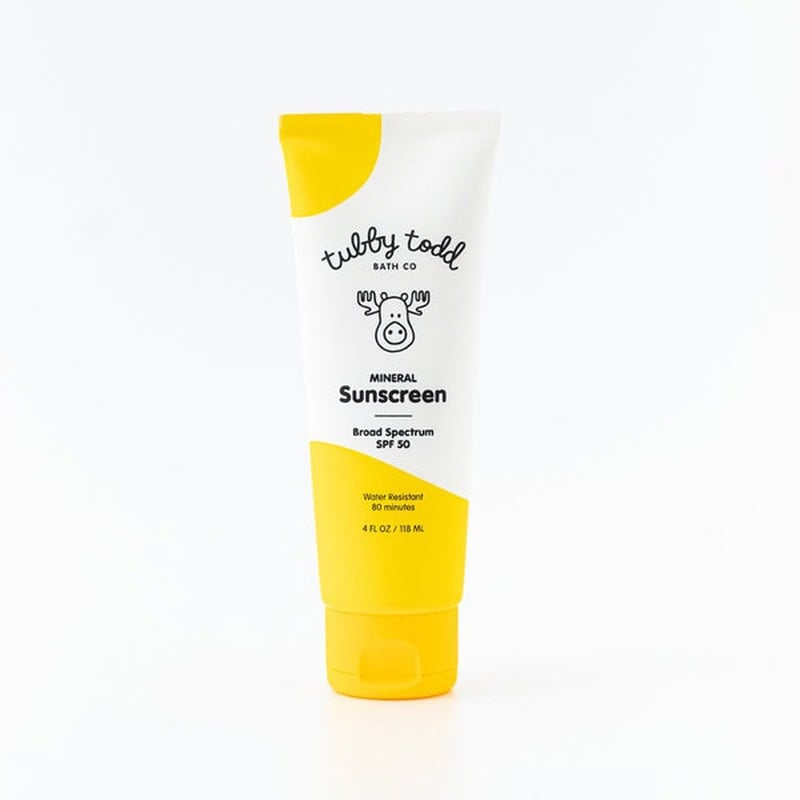
The link above gives you 10% off automatically, which softens the splurge a little.
6. Best Stick for Face: Earth Mama Baby Mineral Sunscreen Stick SPF 40
Pediatric dermatologists tend to recommend stick sunscreens for baby faces, because lotions migrate into eyes the second a baby rubs them. This is the cleanest-ingredient stick I trust, but the 40-minute water resistance is a real limitation. So for me, it’s a face and ears only thing.
The stick format that solves the migrating-into-eyes problem lotions can't.
Earth Mama's whole brand reputation is built on clean ingredients for pregnancy and baby, and this stick lives up to it.
Made for full-body use, but where it really earns its place is on baby faces and ears. You know, the parts that get the most sun and the least patience for applying sunscreen.
Pro tip: Warm in your palm for ten seconds before applying so it doesn't drag
- 22% non-nano zinc oxide
- EWG Skin Deep rating of 1 (best possible score)
- Fragrance-free
- Travel-friendly (no liquid TSA rules)
- Pregnancy-safe (mom-friendly too)
- Only 40-minute water resistance
- Smaller coverage per application than a lotion
- Pricier per ounce than lotion equivalents
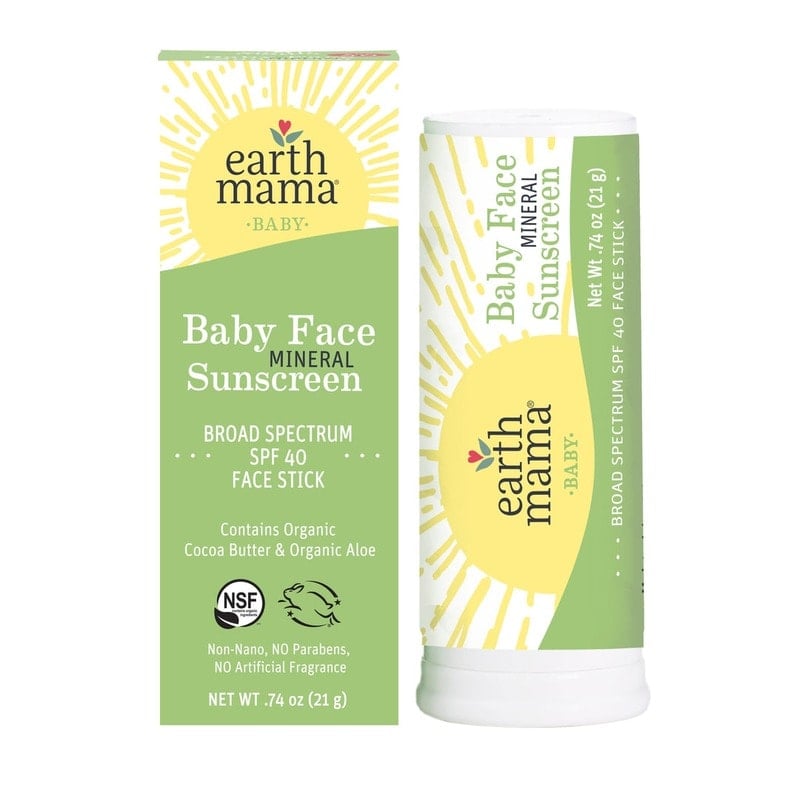
SPF 40 instead of 50 here, which is still well inside the AAP’s recommended 15 to 50 range; not a downgrade, just where this formula landed in testing.
Tip: Warm the stick in your palm for ten seconds before applying so it doesn’t drag on baby skin.
The rules nobody told you
Before we get to the sunscreens, let’s chat about three things the AAP and HealthyChildren.org want you to know about your baby sun safety. None of this is optional.
-
- Under 6 months: shade and clothing first. The AAP recommends keeping infants out of direct sun whenever possible. Use sunscreen only on small exposed areas (face, hands) when shade and clothing aren’t enough.
-
- 6 months and up: broad-spectrum SPF 15–50. Higher than 50 doesn’t meaningfully add protection and can give a false sense of security.
-
- No aerosol sprays for babies. Period. The FDA flags inhalation risk, and sprays make it impossible to see whether you’ve actually covered the skin. Lotions and sticks only.
For ingredient choice, look for zinc oxide at around 20% on the active ingredient panel; that’s the concentration most pediatric dermatologists point to for meaningful protection without the concerns about systemic absorption questions.(The AAP and HealthyChildren.org broadly recommend mineral actives (zinc oxide or titanium dioxide) without pinning a specific percentage, so I like to think of 20% as the well-supported professional consensus rather than a regulatory rule.)
The mineral wash-off problem nobody mentions
Ready for the part every sunscreen article skips even though it drives parents absolute bonkers? Mineral sunscreens are harder to wash off than chemical ones.
Here’s why: Non-nano zinc and titanium dioxide are designed to sit on top of skin and reflect UV. That’s how they protect.
The problem? They don’t dissolve in water-based cleansers the way chemical sunscreens do. Instead, they cling to that precious little baby skin, often leaving a faint white film on the perfect face you just want to stare at without wondering why you can’t get the damn sunscreen off. Oh, and they make your baby smell like sunscreen at bedtime.
But here’s the kicker, friend. The solution to it all. This isn’t a problem with the sunscreen. It’s a problem with the soap.
The fix is an oil-based cleanser. Why, you ask? (Thanks for asking!) Because oil grabs the mineral particles that water-based wash can’t lift, and rinses off without stripping baby skin.
I went on a deep-dive on this problem after a thread in the Motherload village chat had moms were comparing notes on how in the world to actually get off. Here are the two cleansers that consistently win for kid-safe oil cleansing.
Mustela Stelatopia Cleansing Baby Oil
The eczema-friendly oil cleanser from a brand most pediatric dermatologists already know. It’s gentle enough for daily use on broken-out or atopic skin, and it actually lifts thick zinc off without a fight.
The oil-based baby cleanser that actually gets thick mineral sunscreen off skin.
Mustela's Stelatopia line was built for eczema-prone babies, which means it's gentle enough for daily use even on irritated skin.
The oil grabs mineral particles that water-based wash can't lift, and rinses off without stripping the skin barrier.
- True oil-based cleanser (lifts mineral sunscreen the way regular wash can't)
- National Eczema Association accepted
- EWG verified
- Fragrance-free, paraben-free, phthalate-free
- More expensive than standard baby wash
- Not lathery, which takes a bath or two to get used to
- Pump bottle can drip if not stored upright

It’s not lathery (oils don’t lather), which takes a bath or two to get used to.
La Roche-Posay Lipikar AP+ Cleansing Oil
Dermatologist-developed for very dry, eczema-prone skin. The AP+ formula emulsifies on contact with water, which means it lifts mineral sunscreen and then rinses cleanly, with no oily residue.
The dermatologist-developed oil-to-foam cleanser that lifts sunscreen and rinses clean.
The oil base does the heavy lifting on mineral sunscreen; the foam emulsion rinses cleanly without the residue a pure oil sometimes leaves.
The pump bottle? By far the easiest to use when you're one-handed with a slippery, wiggly kid.
- Built for atopic, eczema-prone, very dry skin
- Oil-to-foam formula lifts sunscreen and rinses cleanly
- Dermatologist-developed; widely recommended for pediatric eczema
- One-handed pump bottle works well on a wet kid
- Fragrance-free, paraben-free
- Pricier than standard baby wash
- Bottle is larger and heavier (not travel-friendly)
- Pump can clog if not occasionally rinsed

The pump bottle is genuinely the easiest format for a wet, slippery kid. Slightly heavier price tag, slightly heavier bottle, slightly better experience.
Pro Tips
- Oil first, then regular wash. The order matters. Oil lifts the sunscreen; regular baby wash takes the oil off. If you skip the oil cleanser step, you’ll spend twice as long scrubbing with regular soap.
- Sticks need oil too. Stick sunscreens are even more concentrated than lotions; they need the oil cleanser at the end of the day, especially on faces.
- In a pinch, dish soap works. Janine in our village chat found that dish soap got mineral sunscreen off her hands faster than any baby wash. Not for daily use on baby skin (too stripping), but if you’re traveling and out of oil cleanser, it’s the emergency move.
What about chemical sunscreens?
I want to handle this carefully because there’s a lot of bad information floating around in both directions.
There are all facts.
The American Academy of Dermatology’s official position is that the science doesn’t currently show any sunscreen ingredient available in the US is harmful to human health.
The FDA’s position is that twelve common chemical filters (avobenzone, oxybenzone, octinoxate, homosalate, and others) need more safety data before they can be classified GRASE, but the FDA is explicit that “needs more data” is not the same as “unsafe.”
For your skin? Chemical sunscreens are well-studied, broadly considered safe by dermatologists, and effective. I don’t think anyone needs to throw out their adult sunscreen.
For a baby? Different math. Two reasons:
-
- Babies absorb more. Baby skin is thinner, more permeable, and has a higher surface-area-to-body-weight ratio than adult skin. Whatever absorbs, absorbs at a higher relative dose.
-
- You don’t have to take the absorption question. Mineral options exist, work well, and have no systemic absorption questions hanging over them. There’s no real reason to pick the ingredient class with open regulatory questions when the other class has GRASE status.
The one ingredient I’d specifically avoid on babies, even if it’s not technically banned: oxybenzone. It has the highest systemic absorption of any approved sunscreen filter, lab studies suggest weak estrogenic activity, and the European Commission recommended a maximum concentration of 2.2% (the US allows up to 6%). The science hasn’t confirmed human harm, but for baby skin specifically, this is the one where the risk-benefit math is easiest.
What’s coming this summer that I’m watching
In June 2026, the FDA approved a new sunscreen ingredient called bemotrizinol. It’s the first new sunscreen active approved in the US in over twenty years, and it joins zinc oxide and titanium dioxide as the only three filters with full GRASE status.
What makes it interesting for babies: bemotrizinol is a large molecule (too large to penetrate skin into the bloodstream at meaningful levels) and it’s photostable, which means it doesn’t break down in sunlight the way avobenzone and oxybenzone do. It’s been used in Europe and Asia for two decades with a strong safety record.
The FDA’s new rule takes effect August 9, 2026, so bemotrizinol baby sunscreens could hit US shelves by late summer or fall. I’m not telling you to wait to buy sunscreen now (your baby still needs protection today), but it’s worth knowing about when you’re restocking in a few months. I’ll update this article when I’ve actually tested some of the new formulations.
Why trust us?
I write Undefining Motherhood full-time and have spent years researching baby and kid safety products with the same depth I used to bring to academic research. Every product in this article is mineral, every active ingredient is FDA GRASE, and every safety claim is sourced to the AAP, FDA, EWG, or peer-reviewed research. I’m not interested in fear-mongering, and I’m not interested in pretending all sunscreens are equal. For baby skin, mineral is the conservative-default choice for a reason.
I also moderate a private community (Motherload) where moms share what’s actually working in real time. The wash-off problem in this article came directly from a thread our members started, a level of real-world testing no SEO competitor has access to. Everything here is what I’d hand my best friend if she texted me from the sunscreen aisle.
Baby sunscreen FAQs
The AAP recommends keeping babies under 6 months out of direct sunlight whenever possible and relying on shade, hats, and UV-protective clothing first. Sunscreen can be used on small exposed areas like the face and hands when shade isn’t possible, using a mineral formula with zinc oxide or titanium dioxide.
Mineral is the conservative-default choice for babies. The FDA classifies zinc oxide and titanium dioxide as GRASE (generally recognized as safe and effective), while twelve chemical filters are still classified as ‘needs more data.’ Baby skin is thinner and more permeable than adult skin, so the systemic absorption questions around chemical filters carry more weight on a baby than on an adult.
The AAP recommends broad-spectrum SPF 15-50 for babies 6 months and older. Higher than SPF 50 doesn’t meaningfully add protection and can create a false sense of security. Look for water-resistant formulas (40 or 80 minutes) if you’re swimming or sweating.
Oil-based cleansers work better than water-based baby wash for mineral sunscreen. Mineral particles (zinc oxide, titanium dioxide) sit on top of skin to reflect UV, which means they don’t dissolve in soap the way chemical sunscreens do. Pediatrician-friendly oil cleansers like Mustela Stelatopia Cleansing Baby Oil or La Roche-Posay Lipikar AP+ Cleansing Oil lift the mineral particles cleanly. Use the oil cleanser first, then a regular baby wash to remove the oil.
The bottom line
If you only read the next two paragraphs, here it is.
For a baby 6 months and up, pick a mineral sunscreen with zinc oxide around 20%. If you’re only buying one, make it Blue Lizard Baby Mineral; it’s the one you’ll actually use every day, and the bottle that turns blue in UV light isn’t just clever, it’s useful. If you want the strongest ingredient profile, Thinkbaby. If you want the budget option, Babyganics. If your baby has eczema, Aveeno Baby with the oat extract. For the face, the Earth Mama stick. For the splurge or the brand you already trust, Tubby Todd.
Then keep an oil cleanser in the bath caddy. Mustela Stelatopia or La Roche-Posay Lipikar AP+. It’s the difference between fighting buildup all summer and just having clean skin at bedtime.
And friend, when in doubt: shade and a long-sleeve UPF rash guard beat the best sunscreen on earth. Sunscreen is the layer you add when shade and clothing aren’t enough. That’s it. That’s the whole rule.
More articles that might interest you
-
- Diaper bag essentials (because sunscreen lives in the diaper bag all summer)
-
- Family-friendly vacation spots (so you have somewhere to use it)