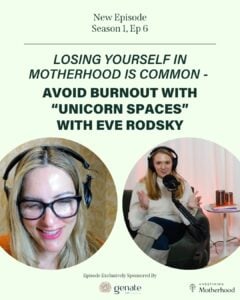
I know the feeling of losing myself in motherhood all too well. Every hour already belongs to someone or something else, and “me time” waits patiently at the very bottom of a list that never ends.
That’s exactly what New York Times bestselling author Eve Rodsky and I got into in Part 2 of our conversation on the Undefining Motherhood podcast. (Part 1 is how to avoid mom burnout with Fair Play.) This one’s about what happens after you rebalance the load at home: finding time that’s actually yours, and keeping it.
In this 11-minute clip, Eve explains:
- The “toxic time messages” that keep moms last
- Tips on what to hand your partner (if you’re in a partnered relationship)
- Why the “mom guilt” you feel when you ask for help usually isn’t guilt at all
- What Unicorn Space is, and why she calls it an antidote to burnout
Want the whole conversation? The full episode is 26 minutes.
What is Unicorn Space?
Unicorn Space is Eve Rodsky’s name for time you spend actively pursuing something that makes you feel like you. She calls it that because, like a unicorn, it’s magical and it doesn’t exist . . . especially for women. Until we make it real.
In her book Find Your Unicorn Space, Eve describes it as an active pursuit with 3 parts:
- Curiosity: something you genuinely want to explore
- Connection: sharing it with other people in some way
- Completion: actually finishing something, even if it’s small and imperfect
That’s why a pedicure or a walk around the block doesn’t count, at least by Eve’s definition (and I have to agree). Those still matter, but basic self-care is the baseline. Unicorn Space is the next layer: the thing you’d crave getting back to if someone handed you an uninterrupted hour.
This site contains affiliate links, meaning that we earn a small commission for purchases made through our site. We only recommend products we personally use, love, or have thoroughly vetted.
The “toxic time messages” that keep moms last
Before we could even get to Unicorn Space, we had to talk about the stories that make us give our time away. Eve calls them “toxic time messages.” Some come from a partner (“You’re the better multitasker”). A lot of them come from our own heads, from voices we’ve internalized through a lifetime of training.
A few toxic time messages we often hear:
- “My partner makes more money than me”
- “My job is more flexible”
- “I’m on maternity leave, so I can’t ask for anything”
Eve’s take? Those are short-term situations. The patterns you set during them can last for years.
“If you don’t set those patterns up front,” she told me, “you’re going to spend the rest of your life dismantling them.”
(Raise your hand if you’ve told yourself at least one of these. No judgment.)
If night shifts won’t work, hand over these instead
We also chatted about new parenthood, and my love for sleeping in shifts to optimize mom’s postpartum recovery. While that works for a lot of families (it’s the whole idea behind The Sleep Shift), it doesn’t work for every family. To be fair, nothing does.
We asked Eve for her thoughts, and her point is that “he has to work in the morning” shouldn’t mean he gets out of everything. If nights are off the table, she wants your partner to fully own things like:
- Bottles and pump parts: boiling, cleaning and getting them ready
- Baby food: knowing what baby needs as you start solids
- Meals: breakfast, lunch and dinner, including what you need while you’re feeding the baby
- Laundry: all of it, start to finish
None of those have to happen at 3 a.m. That’s the whole point.
Mom guilt, or other people’s discomfort?
This is the part I wish every mom heard before she had a baby. Eve borrowed an example from her friend Dr. Becky Kennedy: guilt is the feeling you get when you act out of line with your values. If you yell at a cab driver for getting you to the airport late, sure. Feel guilty. That’s not who you want to be.
Asking your partner to handle the dishes so you can take a real mental-health break? That’s in line with your values. Taking care of your own mental and physical health is one of them.
So what you’re feeling there usually isn’t guilt at all. In Eve’s words, it’s “anticipating other people’s discomfort.”
You’re bracing for the eye roll. The sigh. The “Are you kidding me?” And to hold a boundary, Eve says, we have to get comfortable with other people being uncomfortable with us.
The guilt is real. It just isn’t telling you that you did something wrong.
Why Unicorn Space isn’t optional
And this is why Eve doesn’t treat any of this as a nice-to-have. She has followed women for more than a decade, and she told me that the moms who went back to paid work while still holding two-thirds or more of the household load (and never changed that) were getting sick. She named insomnia, antidepressant use, autoimmune and thyroid issues, even cancer diagnoses. “It was pretty dire out there,” she said.
Her antidote is simple to say and harder to do: be consistently interested in your own life. A sleepy-girl mocktail, a new skincare routine or a once-a-year girls’ trip can all be lovely. Eve’s point is that none of them can carry that weight on their own.
She also warned against letting a “passion gap” last too long. Your interests can go quiet for a season (hello, newborn days). They just can’t stay buried forever.
Pro Tips
- Start smaller than you think. One thing that’s yours this week counts. Tiny absolutely counts.
- Put it on the calendar before everything else is finished. Because everything else won’t be finished.
- Tell one person about it. That’s the connection part, and it makes you a lot more likely to protect the time.
- Finish something, even if it’s imperfect. One page, one sketch, one run. Completion is where the magic happens.
More from Eve Rodsky
If you haven’t heard Part 1, start with my first conversation with Eve about Fair Play. That’s the system that frees up the time in the first place. Her book Fair Play is still the one I recommend most to moms who feel like the default parent for everything.
And if you want the step-by-step version of handing things off at home, my guide to sharing the mental load of motherhood walks you through it.
Why trust us?
I’m Katy Huie Harrison, PhD, a researcher, writer and mom who has spent years studying (and living) the invisible work of motherhood. I host the Undefining Motherhood podcast so moms can hear straight from the experts I trust most, without the fluff.
Everything on this page comes directly from my interview with Eve Rodsky, author of Fair Play and Find Your Unicorn Space. Her quotes are her own words from our episode. The pro tips are mine, from trying (and sometimes failing) to protect my own time.
Unicorn Space FAQ
Unicorn Space is Eve Rodsky’s term for time spent actively pursuing something that makes you feel like yourself. In her book Find Your Unicorn Space, it has three parts: curiosity, connection (sharing it with others) and completion.
No. Self-care like a walk, a nap or a pedicure is still important, but Eve Rodsky describes it as the baseline. Unicorn Space is an active pursuit you share with others and finish, like writing, making art or learning a skill.
Eve Rodsky says guilt belongs to actions that go against your values. Taking care of your mental health doesn’t, so what you feel is often anticipating someone else’s discomfort. Holding a boundary means getting comfortable with that discomfort.
The full 26-minute episode is Season 1, Episode 6 of the Undefining Motherhood podcast, available on Apple Podcasts and Spotify. The 11-minute video clip is on YouTube and at the top of this page.
Your time counts before the list is finished. It always did.
Pick one thing that’s yours this week. Put it somewhere before everything else is done. Tell one person. Then go do it, imperfectly.
More articles you’ll want next
- Overwhelmed mom guide (for when everything feels like too much at once).
- Mom burnout signs (and what recovery actually looks like).
- Rediscovering yourself after motherhood (because the identity shift is real, and you’re not imagining it).