


Let me guess. You’ve read the reviews until that deep space behind your eyes ached like a mother. You’ve asked the group text, watched a dermatologist on TikTok, and face palmed when a crunchy mom on Instagram told you something totally opposite. Somewhere on your laptop, there might be a spreadsheet. And you still don’t know if you’re using the best sunscreen for kids this summer.
Let’s end the spiral here, friend. Some decisions just need to be made, and this is one of them. You’re a good mom, and you don’t need to spend hours studying mineral sunscreens to prove it. Skim below, know you can’t go wrong, place your order, and let this leave your head once and for all, k?
Here’s what’s coming:
- Seven kids sunscreens I’d actually put on my kids (and do)
- Why each one earned its spot
- How to choose in under 90 seconds
Every pick is:
- Mineral (no chemical filters, though I use them sometimes, so no shame here)
- Validated by moms I love and trust (myself included)
- Been cross-checked against DailyMed for the exact active ingredient percentages
So feel good, make a quick choice, and take something off your plate. Let’s do this.

This site contains affiliate links, meaning that we earn a small commission for purchases made through our site. We only recommend products we personally use, love, or have thoroughly vetted.
Kids sunscreen 2026 quick picks
For the scroller, the sleep-deprived, the mom whose kid is asking for popsicles right now:
- Top Body Pick: Blue Lizard Kids Mineral Sunscreen Lotion SPF 50
- Face Fave: Blue Lizard Kids Mineral Sunscreen Stick SPF 50
- Top Sport & Water Pick: ThinkSport Kids Safe Sunscreen SPF 50+
- Best Drugstore: Neutrogena Sheer Zinc Kids Mineral Sunscreen Stick SPF 50+
- Top Sensitive Skin Choice: Badger Kids Mineral Sunscreen Cream SPF 40
- Splurgeworthy Pick: Mustela Mineral Sunscreen Face & Body SPF 50 Lotion
- Best Non-Aerosol Spray: ThinkSport Kids SPF 50 All Sheer Mineral Sunscreen Spray
The 7 best kids sunscreens for 2026
1. Best kids sunscreen for body: Blue Lizard Kids Mineral Sunscreen Lotion SPF 50
The one moms keep coming back to for good reason. What earns Blue Lizard the top spot? It doesn’t sting when it drifts near your kid’s eye, and that alone can save your beach or pool day.
Nerd talk: they did a special Blue Algae reformulation in 2024 to achieve this, and I’d call it far more golden than blue.
- Titanium dioxide 8% + zinc oxide 10% (100% mineral, no chemical filters)
- 80-minute water resistance — pool and beach approved
- Fragrance-free, paraben-free, hypoallergenic
- Doesn't sting near eyes (repeatedly noted in Reddit reviews)
- Reef-safe — no oxybenzone or octinoxate
- White cast possible on deeper skin tones (lower zinc % helps, but still present)
- Thick texture needs thorough rubbing in — not a one-swipe product
- Can be hard to rinse off completely at end of day

Heads up: some white cast still shows on deeper skin tones, but it’s manageable.
One thing to watch: Blue Lizard makes two Kids Lotion versions, and only one is fully mineral. The link above goes to the mineral tube. So if mineral-only sunscreen matters to you, double check the ingredients. You’re looking for 2 active ingredients here: Zinc Oxide + Titanium Dioxide only.
2. Best kids sunscreen for face: Blue Lizard Kids Mineral Sunscreen Stick SPF 50
Six-ish seconds. That’s the whole application on a wiggly kid’s face.
Sticks seriously change the emotional dynamic of putting on sunscreen. Instead of watching a blob of lotion that’ll get in their eyes barreling toward their face, your kid sees something kinda like chapstick. Way less scary. Plus the application is fast and you stop touching them within seconds.
- Zinc oxide 20% (high-concentration mineral protection)
- 80-minute water resistance
- Stick format — mess-free, fast, no drip risk near eyes
- Nourishing base (shea butter, aloe vera, jojoba)
- Travel- and diaper-bag friendly
- Needs firm hand pressure on hot days (wax-based formula can soften)
- Less coverage per pass than lotion — multiple swipes for larger areas
- 0.5 oz travel size only — runs out quickly with full-face + reapplication use

It’s the sunscreen that goes on at soccer dropoff, in the pool locker room, or in the car before you leave. Buy two if your kids are at day camp; one for the bag, one for the car.
3. Best kids sunscreen for sports and water: ThinkSport Kids Safe Sunscreen SPF 50+
The one you reach for on beach days, at swim lessons, and for outdoor camp. ThinkSport earned this slot because of how well it stays on the skin, even through swim and sweat. That’s the pick you want for the beach day where your kid will be in and out of water for six hours.
- Zinc oxide 20% (non-nano — no nanoparticles)
- 80-minute water resistance
- Sport-formulated for active outdoor use
- Clean without benzene in independent testing
- EWG-verified safety profile
- Texture can feel greasy/sticky on skin (thicker than lotion-style picks)
- Harder to spread quickly on a wiggly child vs. lighter-formula options
- Less widely available in physical stores than Blue Lizard or Neutrogena

The texture is thicker and stickier than Blue Lizard, so it’s not your daily driver for a texture-sensitive kid, but worth the negotiation on high-exposure days.
4. Best drugstore kids sunscreen: Neutrogena Sheer Zinc Kids Mineral Sunscreen Stick SPF 50+
The one you can grab at any Target at 9pm the night before camp.
Drugstore sunscreens have a reputation problem they shouldn’t have. Neutrogena Sheer Zinc Kids is a genuinely well-formulated mineral stick that you can absolutely feel good about using on your kids.
- Zinc oxide 21.6% (high-concentration mineral)
- 80-minute water resistance
- Available at Target, Walmart, CVS — no waiting for shipping
- Fragrance-free, oxybenzone-free, paraben-free
- Stick format — fast, no-mess face and body application
- Not labeled non-nano zinc (may be micronized)
- White cast on deeper skin tones (21.6% zinc)
- Smaller stick (0.47 oz) runs out quickly for full-body use on older kids
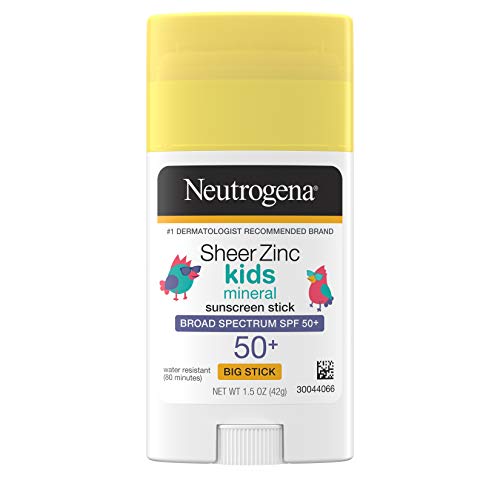
Perfect for the glove-compartment backup you can replace easily.
5. Best kids sunscreen for sensitive skin: Badger Kids Mineral Sunscreen Cream SPF 40
For the kid whose skin has strong opinions about everything, and it never stops screaming at you (or them, poor baby.) If your kid has reacted to three sunscreens already, this is where I’d send you next.
Designed specifically for eczema-and-allergy-prone skin, the ingredient list is short by design. It’s the sunscreen you reach for when their skin is mid-flare (or just to avoid the flare altogether.)
- Zinc oxide 22.5% (non-nano — highest concentration on this list)
- Only 9 ingredients, 98% organic, EWG score of 1
- Reef-safe — no marine-harmful ingredients
- Hypoallergenic, gluten-free, no synthetic fragrance or dyes
- The gentlest formula for eczema, sensitivities, or multi-product reactions
- 40-minute water resistance (all other picks are 80-min — most vigilant reapplication needed, especially near water)
- Thicker texture — takes more rubbing in than lighter formulas
- Tangerine & vanilla scent (from essential oils) — test on sensitive kids first
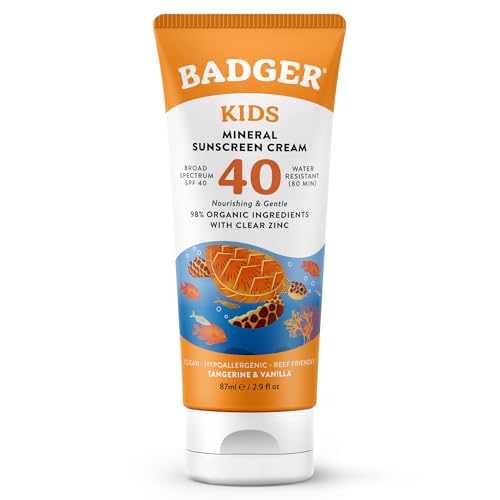
The drawback? 40-minute water resistance. Every other pick on this list is 80-minute.
But here’s the thing. Badger designed the shorter window so they could formulate cleaner, so it’s still the right pick for some kids. Just set a phone timer at the pool. That trade-off is the price of the gentlest formula on this list.
6. Best splurge kids sunscreen: Mustela Mineral Sunscreen Face & Body SPF 50 Lotion
From the brand already in your medicine cabinet. Mustela earns the splurge slot on brand-trust momentum. If you already reach for their diaper cream and cradle cap oil, this sunscreen sits inside a formulation approach you already know works for your kid’s skin.
- Zinc oxide 24% (high-concentration mineral protection)
- 80-minute water resistance
- No parabens, phthalates, phenoxyethanol, or chemical UV filters
- Hawaii reef-safe compliant
- Family-formulated — same lotion works from baby up through school age
- Premium price point (more expensive than drugstore picks)
- Non-nano zinc status not explicitly labeled
- Thicker lotion texture (24% zinc = more rubbing in required)

This isn’t the tube you drain over Memorial Day weekend. But it is the one that stays home for the tender moments when their skin’s feeling sensitive or (gasp!) already burned. (It’s okay. Seriously. It happens to all of us.)
Quick note on Amazon’s name trap: the listing title says “Mustela Baby Mineral Sunscreen.” Don’t scroll past it. Mustela’s whole brand identity is baby-product naming; the formula is family-formulated and shows up in kids’ sensitive-skin threads as often as it does baby ones.
7. Best non-aerosol spray kids sunscreen: ThinkSport Kids SPF 50 All Sheer Mineral Sunscreen Spray
For the kid who flinches at the sight of the lotion bottle. You know that kid. Because it might be your kid, and it’s actually a lot of kids. The one who runs when you open the tube.
A pump spray gives kids a sense of control over the moment, which makes a bigger difference than most of us realize. A kid who feels like they have some control over applying sunscreen is a kid who fights it less.
- Zinc oxide 15.7% + titanium dioxide 3.4% (non-nano mineral blend)
- 80-minute water resistance
- Non-aerosol pump spray — no propellant inhalation risk
- Clean independent testing track record (ThinkSun family)
- SPF 50 with no chemical UV filters, oxybenzone-free
- Still requires rubbing in after application — not truly hands-free
- Non-aerosol pump can run out faster than lotion
- Harder to find in physical stores than Blue Lizard or Neutrogena

The AAP guidance TikTok gets wrong: the American Academy of Pediatrics doesn’t say “never use spray sunscreen.” They give basic guidance that’s kind of obvious, like not spraying your kid’s face and avoiding inhaling the mist. I won’t pretend I haven’t pulled out a spray bottle of Sun Bum and said, “Close your eyes, hold your breath, and spread eagle” in plenty of pinches. And I will again.
This spray gives even more control and is safer (and more environmentally-friendly) because it’s not aerosol.
How to pick the best kids’ sunscreen (in 90 seconds)
Here’s the truth about kids sunscreen nobody says out loud (because fear-mongering gets more clicks than calm truths): most of what’s on the shelves is fine. Not perfect for everyone. But fine. Your kid isn’t going to burn because you grabbed the wrong bottle in a Sunday-night panic.
That said, if you’re researching kids’ sunscreens, you’re probably concerned about the safest sunscreen for kids. So I’m here to help, with a quick reframe.
The actual question isn’t “which kids’ sunscreen is the best,” but instead, “which best fits your kid’s skin, your family’s priorities, and your budget?”
Three questions get you to the right pick fast:
- Where will your kid wear it most? Pool, park, sports, or just running around outside? Water and sweat mean 80-minute water resistance matters more than SPF number. Casual outdoor play means texture and reapplication ease matter more.
- How sensitive is your kid’s skin? If they’ve reacted to sunscreens before, you want the shortest ingredient list and the highest zinc percentage. If they haven’t, you have more flexibility on texture.
- How allergic to sunscreen application is your kid? (Not medically. Emotionally.) If they scream when they see the bottle, a stick or a spray will save your sanity more than a lotion will.
That’s it. That’s the whole framework. Let’s get to the picks.
What actually matters when choosing kids sunscreen
Want a quick sunscreen-for-kids sanity check?
Look for “mineral” or “physical” on the front of the bottle. These sunscreens use zinc oxide and/or titanium dioxide as active ingredients. They sit on top of skin and reflect UV, rather than absorbing into it. That’s the difference between mineral and chemical filters, and it’s the reason the AAP prefers mineral sunscreens for younger kiddos.
Check the active ingredient percentage. For zinc oxide, you want 15-25% for kids’ outdoor use. Below 10%, protection is thinner. Above 25%, you’re paying for coverage most kids don’t need.
“Non-nano” for the cautious mom. Non-nano zinc uses larger particles that don’t penetrate skin. All Badger and ThinkSport picks on this list are labeled non-nano. Blue Lizard and Neutrogena aren’t explicitly labeled, but the concentrations and formulations suggest they’re not nano either. If non-nano is a hard line, go with Badger, ThinkSport, or another labeled brand.
Water resistance number matters more than SPF for outdoor use. SPF 40 vs. SPF 50 is a minor practical difference (both block 97-98% of UVB). But 40-minute vs. 80-minute water resistance changes how often you’ll reapply.
A note on heavy metals in sunscreen. Lead Safe Mama’s 2026 expanded testing found detectable lead in the majority of sunscreens tested (mineral, chemical, adult, kids). This is a broader industry issue with the mining and refinement of mineral ingredients, not a scandal specific to any single brand.
Kids sunscreen spec comparison
| Product | SPF | Active Ingredient | % | Water Resistance | Format | Non-Nano | Reef-Safe |
|---|---|---|---|---|---|---|---|
| Blue Lizard Kids Lotion | 50 | Zinc + Titanium Dioxide | 10% + 8% | 80 min | Lotion | Not labeled | ✓ |
| Blue Lizard Kids Stick | 50 | Zinc Oxide | 20% | 80 min | Stick | Not labeled | ✓ |
| ThinkSport Kids | 50+ | Zinc Oxide | 20% | 80 min | Lotion | ✓ | ✓ |
| Neutrogena Sheer Zinc Kids | 50+ | Zinc Oxide | 21.6% | 80 min | Stick | Not labeled | ✓ |
| Badger Kids Cream | 40 | Zinc Oxide | 22.5% | 40 min | Cream | ✓ | ✓ |
| Mustela Face & Body | 50 | Zinc Oxide | 24% | 80 min | Lotion | Not labeled | ✓ |
| ThinkSport Kids Spray | 50 | Zinc + Titanium Dioxide | 15.7% + 3.4% | 80 min | Spray | ✓ | ✓ |
Why trust us?
Why trust us?
A PhD, anxiety mama, and research junkie, I take product recommendations seriously. Kids sunscreen has been on my radar for a decade, and I’ve fought all the battles and tested all the options. For this article, I cross-checked every product against DailyMed (the FDA’s active ingredient database), the manufacturer’s own current specifications, and independent testing from EWG and Lead Safe Mama’s 2026 report.
I also consulted with moms in my trusted community and read hundreds of threads to surface what real moms are actually saying about each product. The research confirms what’s safest; personal use and talking to other moms surfaces day-to-day details manufacturer copy tends to leave out (eye stinging, texture, white cast on different skin tones, kids who won’t tolerate certain formulas). Nothing here is sponsored.
Kids sunscreen FAQ
The safest kids sunscreens are 100% mineral (zinc oxide, titanium dioxide, or both), with none of the chemical filters — oxybenzone, octinoxate, avobenzone, octisalate — that some parents want to skip. Blue Lizard Kids Lotion, ThinkSport Kids, and Mustela Face & Body are all solid picks. Look for “mineral,” “physical,” or “non-nano” on the label.
Mineral sunscreens sit on top of the skin like a shield; chemical sunscreens soak in and convert UV into heat. Same protection, different mechanism. For kids (especially little ones with sensitive skin), the AAP prefers mineral.
SPF 30 to SPF 50 covers what most kids need. SPF 30 blocks about 97% of UVB rays; SPF 50 blocks about 98%. Practical difference: basically none. What actually matters is applying enough (most of us under-apply) and reapplying on the schedule the label calls for.
Stick sunscreen for the face; it’s faster and way less likely to drift into their eyes. For the body, a Solar Buddies sponge applicator turns lotion application into something kids find less horrifying (some even want to help). Apply 15-30 minutes before you head outside so it has time to set.
With the right technique, yes. The AAP says spray into your hands first, then apply. Don’t directly on their face, and avoid inhaling the mist. Non-aerosol pump sprays sidestep the propellant thing entirely (and mineral sprays weren’t part of the 2021 benzene panic that hit chemical aerosols).
Every 80 minutes if they’re in and out of water; every 2 hours if they’re just running around; right after toweling off. Always check your specific label; some have shorter water windows. The biggest sunscreen mistake is applying in the morning and not again all day.
One last thing
Whatever you pick, here’s the truth nobody says: the best sunscreen is the one that actually gets applied. And reapplied. Rubbed all the way in; not just smeared across the top layer of skin.
A perfect mineral sunscreen sitting in the bottom of your beach bag because your kid hated the smell isn’t protecting anyone. A drugstore SPF 50 that your kid tolerates and you actually remember to reapply is doing more work than the fanciest formula on the market.
Pick the one that fits your kid’s skin, your family’s priorities, and your patience level. Get through this summer. Come back next year and we’ll figure out what’s changed.
More articles you’ll want next
- The best baby sunscreen for 2026 (for the sibling under a year, or if you’re building a family sunscreen kit from scratch)
- The best pregnancy-safe sunscreens (because if you’re chasing a toddler around a pool, you’re also getting a lot of sun on your face)
- How to share chores with your kids (including “apply your own sunscreen” as an age-appropriate task that will save your sanity)
- Encouraging toddler independence without losing your mind (the framework that also happens to make sunscreen application 40% less horrible)